
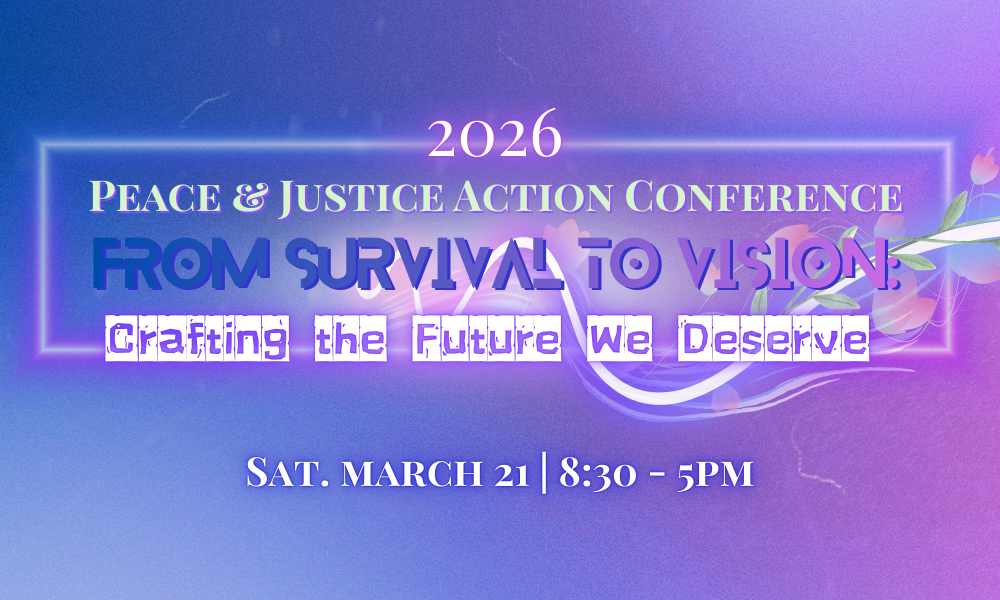
From Survival to Vision:
Crafting the Future We Deserve
Saturday | March 21, 2026
8:30am – 5:00pm
Location TBA
The 2026 Peace and Justice Action Conference will focus on going beyond reaction and into response. Grounded in real-world struggle and guided by imagination, we will explore how care, creativity, strategy, and solidarity can shape futures rooted in dignity, justice, and collective well-being. Together, we will strengthen our analysis, sharpen our tools, and deepen our relationships, not to survive what is, but to craft what should be.
From Survival to Vision invites us to pause, breathe, and ask a different set of questions: What are we moving toward? What does collective liberation look like in practice? And how do we build it together?
Ticket Prices
Cooperative Fund $150
Covers full cost of attendance for one person and half of the cost for another person
True Cost $100
Full cost of workshop calculated from organizing expenses (i.e. facilitators, food, materials, etc.)
PJALS Member Rate $50
For folks who have made 1 or more membership donations to PJALS in the last 12 months, also open to members of co-sponsoring organizations!
Living Lightly $20
Self-identified low-income, students, seniors, artists, etc.
If the cost of registration is a barrier, please contact Shantell Jackson at [email protected]
Keynote
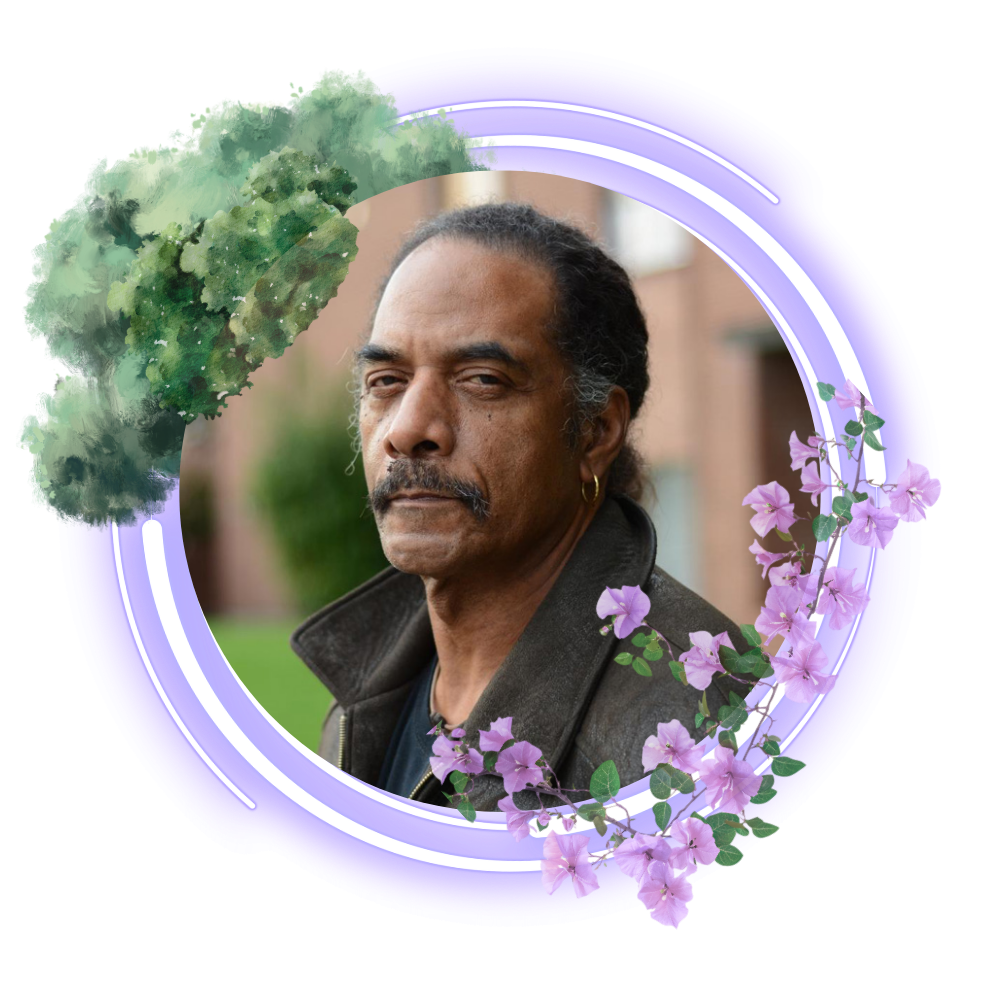
Aaron Dixon | Former Seattle Black Panther Party Captain
Aaron Dixon is a longtime organizer, author, and movement leader whose life’s work spans Black liberation struggles, community health, housing justice, and youth leadership. As a teenager in Seattle, he marched with Martin Luther King Jr. for housing justice and was an early participant in school integration efforts—experiences that shaped his lifelong commitment to racial and economic justice.
My People Are Rising
In 1968, Dixon helped co-found the Seattle chapter of the Black Panther Party, becoming its first captain and helping to establish community survival programs that addressed urgent needs like food access, healthcare, and legal support. Among these efforts was the Free Breakfast for Children Program and the opening of a free community medical clinic that continues today as Carolyn Downs Family Medical Center.
Following his years with the Panthers, Dixon continued his work in community-based organizations focused on violence prevention, housing, and support for unhoused youth. He later founded Central House, a nonprofit providing transitional housing and leadership development for young people. In 2006, Dixon ran for U.S. Senate in Washington State, using the campaign as a platform to call for peace, same-sex marriage, healthcare for all, and an end to the war on drugs.
Dixon is also the author of My People Are Rising, a powerful memoir reflecting on movement-building, political education, and the ongoing work of liberation. For his keynote, we will sit down with Aaron and discuss his perspective on moving From Survival to Vision—rooted in history, grounded in community, and oriented toward Crafting the Future We Deserve.
Conference Tracks
Visioning the Possible
This track asks the big question: What are we moving toward? It grounds imagination in reality, exploring what’s possible when communities design systems rooted in care, dignity, and shared abundance.
Generative Justice: An Indigenous Vision of Community Building
LaRae Wiley & Christopher Parkin
Throughlines – A Cause for Solidarity
Patricia Kwan, Emily Daley, Scott Romney, Patricia Castaneda,
Luke Baumgarten, Victoria O’Banion
A Language of Life: Why and How We Can Strengthen Our Analysis,
Sharpen Our Tools and Deepen Our Relationships
Jane Brenneman & Charles Thomas
Grasping at the Roots
Duaa-Rahemaah & Taylor Birdtail
Keynote Breakout
Aaron Dixon
Rest, Joy, & Revolutionary Care
Joy is a part of the work. This Track centers sustainability, embodiment, and creative practices that keep movements alive for the long haul.
Caring for Self as You Fight for Others
Dr. Melissa Mace
Art & Grit: Community and Self-Care for Resistance
Anna Marie Martin
Reclaiming Ourselves and Our Power Through Embodiment
Liz Moore & Lex Gavin
Collage the Future
Carl Richardson
Issues at the Frontlines
Issues at the Frontlines focuses on the most urgent struggles facing our communities right now. This track brings together organizers, advocates, and directly impacted leaders to examine current threats, share strategies, and build coordinated responses rooted in solidarity, care, and collective power.
Demystifying CRT: A Beginner’s Guide to Critical Race Theory
Deqa
Addressing Social Injustice through the Application of Crucial Conversation Development
Dr. Nick Payton
Universal Healthcare in Washington State: The Plan to Win and How You Can Be Part of It
Jennifer Banks
Rapid Response Community Safety Training
Margot Mejia
Organizing
This is the nuts-and-bolts track, skill-building for organizers at every level, from new folks to seasoned leaders.
The Boycott, Divest, Sanction Movement
Abby Saks, Morton Alexander, Susan Tyler Babkirk, Emily Fletcher
10 Things Every Activist Should Know
Fenrir Close & Wyktoria Taschler
Washington Neighborhood Defense: Small Business Organizing
Gian Mitchell
Everyday Resistance to Authoritarianism 101
Kate Bitz & Fenrir Close
Leading with Liberation in Mind: Remembering Who We Come From to Sustain the Work
Annmarie Caño
Conference Schedule
9:00 – 9:30am – Conference Opening Plenary
9:30-9:45a – Networking Break
9:45-11:15 am (90 Min)
Session 1
Throughlines – A Cause for Solidarity
Presenter(s): Patricia Kwan (she/her) – Director, WACEO
Emily Daley (she/her) – WACEO
Scott Romney (he/him) – WACEO
Patricia Castaneda (she/her) – Manzanita House
Luke Baumgarten (he/him) – RANGE Media
Victoria O’Banion (she/her) – Northwest Cooperative Development Center
Track: Visioning the Possible
Movements often organize by issue area – housing, food, health, labor, peace, climate – yet the forces shaping these struggles are deeply interconnected. Throughlines: A Cause for Solidarity is a participatory, systems-mapping session that invites participants to surface the shared themes running beneath seemingly distinct causes and organizations.
Rather than starting from difference, this session begins with lived advocacy work and asks: What are we really fighting for? Participants will map their organizational missions, the issues they advocate for, and the deeper values and systems at play – such as dignity, economic security, self-determination, care, and collective wellbeing.
The session culminates in a shared reflection on collective vision – including how a common narrative can help organizations uplift one another, coordinate messaging, and reinforce each other’s campaigns – moving beyond siloed issue frames toward an integrated understanding of the session culminates in a shared reflection on collective vision – including how a common narrative can help organizations uplift one another, coordinate messaging, and reinforce each other’s campaigns – moving beyond siloed issue frames toward an integrated understanding of a wellbeing-centered future where everyone who lives here thrives. Participants leave with a stronger sense of solidarity, sharper political analysis, and new relationships grounded in shared purpose, and actionable, tangible ways they can support one another in their work.
Art & Grit: Community and Self-Care for Resistance
Presenter(s): Anna Marie Martin – Founder, SpokeAnna
Track: Rest, Joy & Revolutionary Care
This 75-minute interactive workshop explores how creative practice sustains social movements through difficult times. Using case studies from movements including the Montgomery Bus Boycott, Black Lives Matter, Standing Rock, and others, participants will engage in body-based warmups, small group analysis, and collaborative ritual creation to examine how art functions as both resistance and care. We’ll reframe self-care beyond individual wellness to explore community care as the practice of carrying each other when things get rough.
Through improvisation and embodied practice, participants will create practical tools for sustaining themselves and their communities in long-haul organizing work. This workshop honors five principles: art is survival infrastructure, not luxury; creative practice adapts to your changing capacity; art is a repeated practice, not a product; creative work builds worlds we don’t need to escape from; and small groups practicing together change everything.
Universal Healthcare in Washington State: The Plan to Win and How You Can Be Part of It
Presenter(s): Jennifer Banks (she/her) – Spokane County Educator, Whole Washington
Track: Issues at the Frontlines
Our country is in a healthcare crisis, and our federal government is failing to act. Federal support for Medicare and other safety-net programs is being rolled back, making life more difficult for millions of people. No one should face bankruptcy simply because they got sick or injured.
Washington State – along with a few others – is closer than ever to achieving universal healthcare at the state level, much like how Canada won its single-payer healthcare system. Whole Washington is a statewide organization working to make this vision a reality, but we can’t do it alone.
We currently have several bills in the legislature, but if our representatives continue to fail to act, we know this is something the people can pass through a ballot initiative. This grassroots effort to remove the profit motive from healthcare – where it never belonged – offers a powerful example of how we can work together to reclaim our power from systems that prioritize profit over people.
The Boycott, Divest, & Sanction Movement
Presenter(s): Abby Saks (she/her)
Morton Alexander (he/him)
Susan Tyler Babkirk (she/her)
Emily Fletcher (she/her)
Track: Organizing
What is the Boycott, Divestment, and Sanctions movement, and why has it become a focal point of global solidarity efforts? This session will trace the history of BDS, examine its impact and ongoing campaigns, and discuss why supporters view it as a strategy rooted in international law and nonviolent resistance.
We will also explore the International Holocaust Remembrance Alliance (IHRA) definition and its role in debates over free speech and advocacy. Participants will leave with concrete ways to engage locally — including through Apartheid-Free Zones — and insight into the future of BDS organizing in Spokane. Ample time will be provided for discussion and questions.
A Language of Life – Why and How We Can Strengthen Our Analysis, Sharpen Our Tools and Deepen Our Relationships
Presenter(s): Jane Brenneman (she/her) – NAACP, BRCI
Charles Thomas (he/him)
Track: Visioning the Possible
When trying to shape futures rooted in dignity, justice, and collective well-being it is important that we free ourselves from old programming. Join us for an interactive and reflective workshop focused on ways to replace our current “power-over” linguistics with the mindset and language of “power-with”. Come explore how to help us connect with each other through honesty and empathy.
Leading with Liberation in Mind: Remembering Who We Come From to Sustain the Work
Presenter(s): Annmarie Caño (she/her/ella) – Professor, Gonzaga University
Track: Organizing
The work of collective liberation can feel overwhelming at times, with leaders running the risk of burnout or losing faith in their efforts. One way to stay rooted in the joy of resistance is to engage in autoconocimiento (self-knowledge) and acompañamiento (accompaniment), two practices that are rooted in Latin American liberation psychology. In this workshop, Dr. Annmarie Caño will provide an overview of Latin American liberation praxis and explain why it is relevant in today’s current sociopolitical context. She will also engage participants in an exercise to bring greater awareness of who we come from and why we accompany others.
11:15 – 11:30am – Networking Break
11:30 – 12:15pm
Keynote Plenary
A Moderated Discussion with Aaron Dixon
Aaron Dixon | Former Seattle Black Panther Party Captain & Co-Founder is a longtime organizer, author, and movement leader whose life’s work spans Black liberation struggles, community health, housing justice, and youth leadership. As a teenager in Seattle, he marched with Martin Luther King Jr. for housing justice and was an early participant in school integration efforts—experiences that shaped his lifelong commitment to racial and economic justice.In 1968, Dixon helped co-found the Seattle chapter of the Black Panther Party, becoming its first captain and helping to establish community survival programs that addressed urgent needs like food access, healthcare, and legal support. Among these efforts was the Free Breakfast for Children Program and the opening of a free community medical clinic that continues today as Carolyn Downs Family Medical Center.
Following his years with the Panthers, Dixon continued his work in community-based organizations focused on violence prevention, housing, and support for unhoused youth. He later founded Central House, a nonprofit providing transitional housing and leadership development for young people. In 2006, Dixon ran for U.S. Senate in Washington State, using the campaign as a platform to call for peace, same-sex marriage, healthcare for all, and an end to the war on drugs.
Dixon is also the author of My People Are Rising, a powerful memoir reflecting on movement-building, political education, and the ongoing work of liberation. For his keynote, we will sit down with Aaron and discuss his perspective on moving From Survival to Vision—rooted in history, grounded in community, and oriented toward Crafting the Future We Deserve.
12:15 – 1:15pm – Lunch Break
1:15 – 2:45pm (90 Min)
Session 2
Keynote Breakout
Presenter(s): Aaron Dixon (he/him), Former Seattle Black Panther Party Captain & Co-Founder
Track: Visioning the Possible
The Peace & Justice Acton League is honored to welcome Aaron Dixon, former Seattle Black Panther Party Captain & Co-Founder as this years Keynote for the Peace & Justice Action Conference. After the Keynote discussion, attendees will have the opportunity to hear more from Mr. Dixon as he talks more about his experiences, and his memoir, My People Are Rising. Time will be provided to ask questions and connect more with Aaron Dixon.
Caring for Self as You Fight for Others
Presenter(s): Dr. Melissa Mace (she/her) – Executive Director, NAACP
Track: Rest, Joy & Revolutionary Care
Dr. Melissa Mace, based in Spokane, WA, is a dedicated social work professional, educator, and clinical leader specializing in trauma-focused care, behavioral therapy, and community engagement.
The goal is to do good work for a lifetime. We are focusing on the long game, understanding passion often propels us forward yet does not often maintain the drive needed. In this series we will work to understand the role balance, boundaries, and reflection have in advocacy work. Self-care is not selfish, it is mandatory for this work.
Addressing Social Injustice through the Application of Crucial Conversation Development
Presenter(s): Dr. Nick Payton – Educator/ Assistant Professor, Simpson College
Track: Issues at the Frontlines
This topic focuses on addressing social injustice through the application of crucial conversation development specifically by connecting the importance of belonging and inclusion in multiple spaces through the art of engaging in crucial conversations that promote social-emotional development and connectedness. Crucial conversation activities will enhance students’ learning experience through active practice and knowledge application.
Everyday Resistance to Authoritarianism 101
Presenter(s): Kate Bitz (she/her) – Senior Organizer, Western States Center
Fenrir Close (it/he) – Jr. Youth Organizer, PJALS
Track: Organizing
Our country and our communities face a fascist power grab to benefit billionaires. But, we aren’t the first people who have dealt with this. Movements throughout history and around the world have faced down authoritarianism and won, using powerful nonviolent tools of collective noncompliance and mass noncooperation. When we refuse to acquiesce at a massive scale, anti-democracy actors can be stopped in their tracks. This highly interactive workshop will share key strategies and ways to take action, and serves as a tasting menu for PJALS’ all-day workshop offering “People Power: Creative Resistance Against Authoritarianism” which is offered year-round.
Collage the Future
Presenter(s): Carl Richardson
Track: Rest, Joy & Revolutionary Care
This interactive workshop explores the intersections of art and activism. Participants will begin with a brief introduction to the history of artists using creative practice as a tool for social change.
Participants will then be guided through a hands-on collage-making process that invites reflection, imagination, and visioning. Using images, words, and textures, participants will create visual representations of the future they desire and deserve—both personally and collectively.
No prior art experience is necessary. All materials will be provided.
Washington Neighborhood Defense: Small Business Organizing
Presenter(s): Gian Mitchell (he/him) – Regional Organizer, PJALS
Track: Organizing
Immigration & Customs Enforcement (ICE) and Customs & Border Protection (CBP) have targeted immigrant communities with raids, detention, surveillance, and deportation since these agencies were created. This violence has been ongoing for years and has sharply increased since this regime came into power. Many workplaces still lack clear information about their rights when immigration agents appear.
In partnership with Washington Neighborhood Defense (WAND), PJALS is building a volunteer canvassing team to inform workplaces across Spokane County about their Fourth Amendment protections and how they apply in an immigration context. Volunteers will distribute rights information, signage, and whistles used in community rapid response to ICE activity.
In this pilot training, participants will learn the basics of workplace rights, how to approach and communicate with local businesses, and how workplace organizing can contribute to broader strategies of collective resistance. Roleplay exercises will give participants the chance to practice canvassing conversations.
2:45 – 3:00pm – Networking Break
3:00 – 4:30pm (90 Min)
Session 3
Grasping at the Roots
Presenter(s): Duaa-Rahemaah Hunter (she/her)
Taylor Birdtail (she/her) – Climate Justice Program Director, The Lands Council
In Collaboration with Meaningful Movies
Track: Visioning the Possible
In partnership with Meaningful Movies Spokane, this presentation is a call to action for those who care about environmental and food justice in Spokane. The film Grasping at the Roots is a chance to follow some of the people who are making positive change in Black Environmental Justice in communities. It is a window into the lives of those being hit by economic hardships, community disruptions, and climate change: living next to refineries and other industrial projects while bearing the brunt of a warming climate, and doing something about it.
After the film, we will participate in a discussion on what we can do in Spokane to build food security, community, and bring more equity into Spokane.
Reclaiming Ourselves and Our Power Through Embodiment
Presenter(s): Liz Moore (she/her) – Executive Director, PJALS
Lex Gavin (they, them)
Track: Rest, Joy & Revolutionary Care
Explore body-based practices to deepen self-awareness and resilience! By building fluency in our bodies as a source of information, we can develop greater awareness and choice under pressure so we can powerfully align our actions with our values. Feeling more allows us to organize from the inside out and offers a powerful strategy to combat fascism. In this workshop we’ll explore practices about coordination, embodied noncooperation, and more.
“Somatics feels into how, in a collective or group, patterns of pain can indicate the mass, or intergenerational, trauma people are surviving. And how each of us has the power to help each feel more, heal, and move toward our longings for liberation and justice together.” – adrienne maree brown, Pleasure Activism
Rapid Response Community Safety Training
Presenter(s): Margot Mejia (she/her) – Community Advocacy Liaison, RICS
Track: Issues at the Frontlines
Rapid Response teams are composed of local volunteers and community organizations who stand in solidarity with their communities. They are guided by teamwork, a commitment to social justice, and a deep respect for the shared humanity of immigrants. These volunteers dedicate their time to providing on-the-ground support when it is needed most.
This training is essential to prepare individuals to exercise their legal right to observe, verify, and document ICE or CBP activity in their communities. Rapid Response teams are strictly nonviolent and operate in accordance with the law. Local teams support community by documenting interactions, reminding individuals of their constitutional rights, and connecting impacted community members to local resources.
10 Things Every Activist Should Know
Presenter(s): Wyktoria Taschler (she/he/they) – Jr. Youth Organizer, PJALS
Fenrir Close (it, he) – Jr. Youth Organizer, PJALS
Track: Organizing
Discover the ten most essential lessons for new and seasoned activists to navigate movement-building and organizing effectively.
The questions we ask as Organizers are essential to the process and a successful movement. What are those questions, why do they matter, and how do we answer them? In this workshop, we boil down the 10 most important things a new organizer should know, and how to obtain that knowledge in different situations. Learn the first steps of becoming a successful activist in this interactive workshop! This workshop is a great refresher for experienced activists too – it’s universal knowledge in learning to become an organizer!
Generative Justice: An Indigenous Vision of Community Building
Presenter(s): Christopher Parkin (he/him/his/čniɬts), Co-Founder,
Principal/Business & Grants Manager – Salish School
LaRae Wiley (she/her), Co-Founder – Salish School
Track: Visioning the Possible
We are now firmly entrenched in The Information Age, an age of rapid, unregulated change– economic change, social change, technological change, cultural change, and climate change. As a result of this rapid change, humanity is facing a global multi-crisis that is expressed in reactionary politics, catastrophic economic models, mass extinction, social decay, and the erosion of local sense-making culture. The erosion of local sense-making culture is perhaps the most profound change of this new Information Age. Increasingly, on a global scale, individuals, families and local communities have become confounded, struggling to maintain integrity, autonomy, connection, and community.
Christopher Parkin and LaRae Wiley, co-founders of Salish School of Spokane have been working within a frame-work of Southern Interior Salish culture to begin to rebuild culture, community, and connection in the Urban Native American populations of the Spokane Metro Area. They have focused their efforts around Salish language revitalization as a foundation of community healing, community building, and future visioning.
In the course of their work, it has become clear that the current global human crisis shares much in common with the processes of genocide, colonization, and forced assimilation that Native American peoples have survived. So, in this workshop, Christopher and LaRae will share their model of Indigenous community building and culture revitalization, and how that model might be adopted by non-Indigenous communities to: increase autonomy and solidarity, increase local sense making, and increase community and cultural connections so that on a local level we can effectively respond to the global multi-crisis.
Demystifying CRT: A Beginner’s Guide to Critical Race Theory
Presenter(s): Deqa (she/her), Founder/President – Adjust Narrative
Track: Issues at the Frontlines
Who controls the narrative, especially about marginalized groups and its connection to justifying and legalizing oppression. How history repeats itself using same tactics under different titles.
Are you curious about Critical Race Theory (CRT) and want to understand its fundamentals? Do you ever wonder why was it in the news so often in recent years and its connection to the current climate of the dismantling of social justice in all aspects of society? And what role did you, yes YOU, play in facilitating it? Join us for an engaging and informative workshop that will provide you with a solid foundation in CRT. Critical Race Theory is an interdisciplinary framework that examines how race and racism intersect with law, society, and culture. It is a powerful tool for analyzing and addressing issues of racial injustice and inequality.
4:30 – 5:00pm – Conference Closing Plenary
Event Sponsors
- Asians for Collective Action
- Asians for Collective Liberation Spokane
- ACLU of Washington
- Faith Action Network
- The Fig Tree
- Greater Spokane Progress
- Odyssey Youth Movement
- Pro-Choice Washington
- Spectrum Center Spokane
- Spokane Community Against Racism (SCAR)
- Spokane Regional Labor Council AFL-CIO
- Symbio Consulting
- UFCW-3000
- Veterans for Peace Spokane Ch. 35
- Western States Center
Want to become a Sponsor? Contact Shar at [email protected]
Accessibility Needs
We are committed to providing inclusive and accessible events. Please contact Shantell Jackson at [email protected] or 509-850-0311 by Wednesday March 11 to request ASL interpretation, CART captioning, or other reasonable accommodations. Providing at least 10 days’ notice helps us ensure availability.